
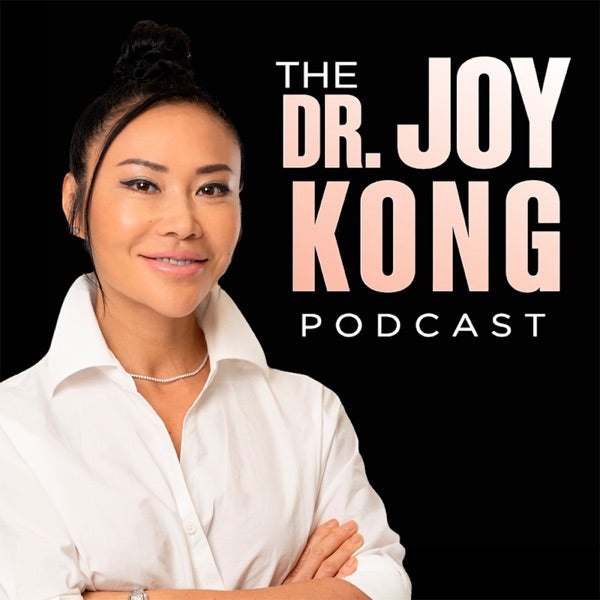
What's Really Driving Your Sugar Cravings? Chris Mearns on The Dr. Joy Kong Podcast

Dr. Joy Kong is a triple board-certified regenerative medicine physician, and her podcast exists to hand listeners mechanisms they can actually use, not just protocols to follow. That framing is why episode 194 works so well. Chris Mearns does not ask her to take fructose metabolism on faith. He walks through the enzyme, the energy math, and the evidence, and Dr. Kong, drawing on 20 years of clinical practice, pushes back with exactly the kind of questions a physician would ask.

The two of them build the fructose model from the ground up: mitochondria as a cell's engine, Dr. Richard Johnson's research reframing fructose as a signaling molecule rather than a simple calorie, and the enzyme fructokinase (KHK) that converts it into ATP loss and uric acid. They cover why the body makes its own fructose from salt and dehydration alone, why bears and hibernation explain more about human cravings than most diet books do, and why Chris still calls luteolin, a compound also studied for its association with graying hair in animal models, the most interesting molecule he has come across in five years of research.

Key moments, the full transcript, and listen links are below. So is a 15% listener code, as a thank you from LIV3.

Dr. Joy Kong, Host, The Dr. Joy Kong Podcast
Dr. Joy Kong | Host, The Dr. Joy Kong Podcast
Now streaming · August 6, 2026

The Real Cause of Sugar Cravings, and the Compound That Stops Them

Episode 194 · 54 min · with Chris Mearns, founder of LIV3

The Dr. Joy Kong Podcast cover art

Dr. Kong and Chris work through what a metabolic disease actually is, why mitochondrial performance can drop the way an engine shifts into eco mode, and where fructokinase inhibition fits alongside GLP-1 drugs and pharmaceutical research already underway. They also cover fruit specifically: why ripening changes fructose's signal, and why Chris still argues against treating fruit itself as a problem. The episode was recorded for The Dr. Joy Kong Podcast and distributed via RedCircle.

This conversation is for informational purposes and is not medical advice.

What we covered
  1. 02:30Why obesity, fatty liver, and brain fog trace back to one shared low-energy cell state
  2. 05:44Mitochondria as the cell's engine, and what it means for that engine to run in eco mode
  3. 08:13Dr. Richard Johnson's research, and fructose reframed as a signal instead of a calorie
  4. 10:34The mechanism: fructokinase (KHK) degrades ATP into uric acid inside the cell
  5. 13:01Bears, torpor, and the survival logic behind the body's "conserve" signal
  6. 15:36What triggers the body's own fructose production, and which organs feel it most
  7. 19:58Gout as a preview: "the disease of kings" and today's food environment
  8. 22:53Cravings, calorie restriction, and why GLP-1 drugs don't repair the engine itself
  9. 26:14Pharmaceutical companies chasing the same fructokinase target
  10. 29:19Not fruit's fault: how ripening changes fructose's signal, and why context matters
  11. 32:45Luteolin identified as a fructokinase inhibitor, and its bioavailability problem
  12. 45:25SugarShield: the formula, and where to find it

Timestamps follow the published episode. Full transcript below.

Why This Matters To Regenerative & Longevity Medicine

Regenerative and longevity practice starts with the same question this episode asks: what determines whether a cell can actually repair itself. Dr. Kong's listeners already track mitochondrial function, inflammation, and cellular energy as inputs to healthspan, and this conversation adds fructose metabolism, the enzyme fructokinase, and its association with uric acid and oxidative stress to that list. It does not replace protocols built on stem cell therapy, peptides, or other regenerative modalities discussed on her show. It offers another upstream variable worth considering when a patient's energy, inflammation, or hormonal markers aren't responding the way the rest of the picture suggests they should.

From The Model To Everyday Practice

From The Model To Everyday Practice

The conversation focused on understanding the model. SugarShield grew from the practical question that followed: if fructose metabolism is an important part of metabolic health, can we support that pathway consistently in everyday life?

You can explore the research first, or continue to the listener trial below when you're ready.

See The 90-Day Listener Trial
Free Resources

Your Free Dr. Joy Kong Podcast Starter Kit

We've assembled a collection of free resources for listeners who want to go deeper.

Inside you'll find:

  • The Fructose Model Starter Guide
  • A 30-Day Metabolic Awareness Protocol
  • Research Summaries & Scientific References
  • Educational Videos & Articles
  • Ongoing Research Updates

Whether you agree with our conclusions or simply find the questions interesting, we hope these resources help you think more deeply about metabolism and health.

We'll also send occasional research updates and new resources. Unsubscribe anytime.

From The Conversation

Three Ideas Worth Sitting With

What stood out from a conversation between two clinicians, framed for people who already think in terms of cellular repair and healthspan.

01

Fructose is being studied as a signal, not just a calorie

Dr. Richard Johnson's team published research reframing fructose as a molecule that regulates metabolic health rather than simply supplying energy. Inside the cell, the enzyme fructokinase (KHK) converts fructose into fructose-1-phosphate, a reaction that consumes ATP and is associated with elevated uric acid. Research links that process to lower baseline cellular energy in tissues like the liver, kidneys, vascular system, and parts of the brain. It is a proposed mechanism, not a diagnosis, but it offers doctors and patients a shared variable behind conditions that usually get treated separately.

02

Cutting sugar doesn't remove the whole signal

The body can convert its own glucose into fructose through a pathway triggered by high blood sugar, dehydration, elevated salt intake, and alcohol. Chris points to this as one reason strict sugar restriction alone can feel incomplete: the same downstream signal stays active even when dietary sugar drops to zero. Understanding these additional triggers may help explain why some patients continue to struggle with cravings and low energy despite already cutting sugar from their diet.

03

Luteolin, studied as a KHK inhibitor, with a delivery problem to solve

Research has identified luteolin, a polyphenol found in celery, parsley, and chamomile, as a compound studied for its potential to inhibit fructokinase. The challenge is bioavailability: research cited in the episode notes standard forms absorb at roughly 7%, compared to as high as 80% in liposomal formulations. SugarShield combines liposomal luteolin with tart cherry extract, which is studied for its association with uric acid support. These statements have not been evaluated by the FDA, and SugarShield is not intended to diagnose, treat, cure, or prevent any disease.

The Research, in Brief

The Fructose Model In Five Minutes

Most discussions about metabolism focus on fuel.

The Fructose Model explores an additional question:

What if metabolism is not only about fuel supply, but also about fuel allocation?

This short video provides a concise overview of the central idea explored throughout our work and serves as the best place to start if you're new to these concepts.

So you're saying the sugar we're eating, part of the sugar is fructose, and that somehow get degraded by this fructokinase into something that end up degrading our energy source.

Dr. Joy Kong
Dr. Joy Kong
Host, The Dr. Joy Kong Podcast
Exploring the Ideas in Practice

Exploring The Ideas In Practice

The conversation on The Dr. Joy Kong Podcast focused primarily on understanding the model.

SugarShield grew out of a simple follow-up question: if fructose metabolism plays an important role in metabolic health, what happens when that pathway is consistently supported over time?

Built directly in response to that research, SugarShield is a practical tool for people interested in applying these ideas in everyday life.

As a thank you for listening, we've included a special offer for the Dr. Joy Kong Podcast audience below.

For The Dr. Joy Kong Podcast Listeners
Code DRJOY
15% off

Applied automatically at checkout.

SugarShield. $49.95. 60 servings per bottle. Precision Fructose Support.

Explore SugarShield
SugarShield by LIV3 Health, liposomal luteolin and tart cherry supplement
SugarShield
Precision Fructose Support
$149.85
60 servings per bottle
Add To Cart
Liposomal formula
98% purity luteolin
Free US shipping
These statements have not been evaluated by the Food and Drug Administration. This product is not intended to diagnose, treat, cure, or prevent any disease.

What To Watch For Over 90 Days

If you decide to explore these ideas in practice, pay attention to patterns that are often overlooked:

01

Cravings and food noise

02

Hunger between meals

03

Daily energy levels

04

Focus and mental clarity

05

Recovery after exercise

06

Body composition

07

Blood sugar and metabolic markers

Episode Transcript

The Real Cause of Sugar Cravings, and the Compound That Stops Them

Read the full conversation between Dr. Joy Kong and Chris Mearns.

Auto-transcribed and lightly edited for readability; speaker labels added by LIV3. Timestamps follow the published episode. The views expressed are the speakers' own. Individual experiences described in the conversation are anecdotal, are not typical results, and have not been evaluated by the FDA.

00:00 Cold open

00:00Dr. Kong:What does it even mean when people say you have a metabolic disease? What is metabolism anyhow?

00:05Chris:I like to think of it as a little engine that's running inside our cells. And that engine can run fast or it can run slow, just like our car. Sometimes we have the ability to actually manually change that to a conserving state where it'll run in eco mode and stretch the resources a little bit further. Fructose itself is not a toxin. It's not going to kill the cell. But if it drops it into this conserving state, then that conserving state is beneficial most of the time, just like the eco mode button on your car.

00:36Dr. Kong:Could that be basically the starting of gout disease?

00:40Chris:I absolutely would say yes to that. It was always the disease of kings. It was those that could eat sugar because they could afford to. Doesn't that sort of sound like our current metabolic state?

00:51 Welcome and introductions

00:51Dr. Kong:Hello, welcome back to The Dr. Joy Kong Podcast. I'm here to help you live a longer, better, and hopefully happier life. So I invite wonderful experts to come on here and share really interesting breakthroughs and products, and just tricks to help you live better. Today I have a very important guest, Chris Mearns, who is going to share with us really interesting things that you need to know about your metabolic health. So Chris, thank you for being here.

01:23Chris:Thank you so much, Dr. Joy.

01:25Dr. Kong:Yeah, so I want to introduce you a little bit to my audience. Chris is a metabolic health researcher and founder who is focusing on the missing layer beneath modern metabolic models. Rather than debating calories, insulin, or hormones in isolation, he studies a shared early energy state that appears across chronic diseases. It's a defensive low-energy posture that forms easily under modern conditions and becomes progressively harder to exit. His work helps explain why existing models are directionally correct, but why popular therapies often help but plateau, and why relapse is so common once intervention stops. Okay, so that's a lot of concepts there. Maybe we'll start somewhere that's a little bit more tangible.

02:30 One shared root beneath separate diagnoses

02:30Dr. Kong:Modern diseases are very problematic. A lot of people are suffering from obesity, from maybe fatty liver or brain fog, and many think of all these problems as separate issues. So how do you view them as branches of really the same origin?

02:53Chris:That's a great question, and I love that your work pulls in a lot of this lens of, are these the same underlying state, or why are they connected? I do believe that they are, and I think there's a lot of evidence for it, because even just looking at a high level, you see that most of these diseases cluster. We've asked, is there a gut-brain axis, for a long time. Why does hypertension and fatty liver so often appear together? It does suggest that there is something underlying the state that is causing multiple breakdowns from a single source, or at least, what is causing this stress.

03:44Chris:From the work that I've done and the research I've read, it does appear that there is a conserving state the body can enter, where it begins to conserve fuel and energy. That doesn't necessarily cause a starvation model where the body starts eating itself, but rather it encourages the body to go find more resources, and hang on to those resources a little bit better. If you think of it from this perspective, if you drop your baseline energy in a cell down, it's not going to die, but it is going to be hungry, and it's going to send a message to the body.

04:38Chris:When it does that, it can begin to support the system it's responsible for less effectively. It's very easy to follow that logic: if that's my liver, then my liver is going to start doing its job poorly. And you can see how eventually, if that's maintained, a pathology can come out of it, and we can start entering diseases.

05:09Dr. Kong:So how are you linking all these diseases? Having been in medicine for over 20 years, we talk about metabolic disease all the time. I was a psychiatrist, and psychiatric medication commonly causes metabolic conditions, and sometimes we put people on metformin to mitigate that. People talk about it as if everyone understands what that means. So first, what does it even mean when doctors tell you that you have a metabolic disease? What is metabolism anyhow?

05:44 Mitochondria as the cell's engine

05:44Chris:That's a good question. I like to think of it as effectively the function, the performance level of our mitochondria on the lowest level, where the job of those little organisms in our cells is to produce energy. It's to pull in glucose and convert it into ATP, or energy. Under that lens, I like to think of it as a little engine running inside our cells, and that engine can run fast or slow, just like our car.

06:21Chris:Typically, we understand that our car can sometimes have a sport mode and be a high-performing engine, or sometimes we have the ability to manually change that to a conserving state where it'll run in eco mode and stretch the resources a little bit further. Oftentimes in our teens and early twenties, it feels like you can eat whatever you want and not gain weight. So we have this innate idea that maybe our metabolism is variable, that it can be slow or fast, even though we don't see a lot of that talked about in the literature.

07:10Chris:But if that holds true, then perhaps our mitochondria can go from a high-performance state to a lower one. And effectively, that's what we're starting to see in the literature: there are many things that can affect the performance of our mitochondria. But the one I find most intriguing is fructose metabolism, because it has a very direct influence on that performance. We might look at toxins, genetics, or many other things affecting cellular energy across the body. But it seems that the majority of those energetic systems are very susceptible to fructose metabolism.

08:07Dr. Kong:But how did you even decide to zoom in on fructose?

08:13 Dr. Richard Johnson's research, and fructose reframed as a signal

08:13Chris:A big reason I fell into this rabbit hole was the work of Dr. Richard Johnson and colleagues out of Colorado. He's been studying fructose metabolism for over 20 years, and the more work they do, the more it seems to resolve a lot of high-level, unanswered questions across many different disease states. I completely defer to his expertise, but it's incredible to see how it starts connecting so many different dots.

08:53Dr. Kong:Okay, so you found this molecule that you think is a culprit for a lot of things. What did you find out about fructose?

08:56Chris:Maybe we should talk about what fructose is, just briefly. We all know that sugar is sucrose, but effectively it's two simple sugars bound together, half glucose and half fructose. We've done a lot of good research on glucose, we appreciate its role, and it's very well studied. Fructose is kind of the quiet neighbor here, because it hasn't seemed to have quite so many direct effects that we've been able to find.

09:36Chris:However, as of very recently, it's starting to be reclassified almost as a signaling molecule. Dr. Johnson's team put out a major review in Nature Metabolism just a few months ago that increased the noise around that change. Fructose is not just being recognized as a calorie anymore, but is actually signaling and regulating metabolic health and disease. That's what the paper stated.

10:34 The mechanism: fructokinase, ATP, and uric acid

10:10Chris:What's happening is that it's being metabolized by cells in a very unregulated way, and in a way that causes that exact kind of drop in baseline cellular energy within the cell.

10:34Chris:To get very briefly into the biochemistry of it, fructose is metabolized by an enzyme called fructokinase, or KHK, and that reaction causes your ATP to effectively be degraded into uric acid within the cell. It steals a phosphate away, and that degradation causes your ATP, your energy, to drop not just to ADP and AMP, but to effectively be degraded to where it can't be recharged anymore. I like to think of them as little rechargeable batteries in our cells that can be boosted back up by mitochondria. But in this state, it degrades into uric acid, a waste product, which then causes reactive oxygen species and inflammation in the cell.

11:25Dr. Kong:So you're saying the sugar we're eating, part of the sugar is fructose, and that somehow get degraded by this fructokinase into something that end up degrading our energy source.

11:40Chris:Exactly, exactly.

11:42Dr. Kong:Well, that doesn't sound very good. So all this sugar you think you're getting energy from ends up robbing you of energy.

11:48Chris:Exactly. It's a really interesting thing, because you're eating glucose, and we recognize that as the body's fuel. The brain runs on it, and so do most of our cells. But we're also sending a signaling molecule along with it that is telling our body to hang on to the fuel as much as it possibly can, and to lower our use of it, which makes sense from a survival adaptation standpoint. If you have opportunity, you want to take advantage of it and preserve it, because it's very likely going to be followed by a scarcity time.

12:37Dr. Kong:You're talking about the fall time, the harvest.

12:40Chris:Exactly, exactly. Before the scarcity.

12:44Dr. Kong:Okay, so when there's a lot of sugar abundant, all the fruits are ripening, you're eating that, and your body is like, oh, it's time to save it.

12:51Chris:Exactly. I better get ready, because it's not going to stay for long, right?

13:01 Bears, torpor, and the ancient survival logic

12:56Chris:Which makes sense with the timing, and it makes sense when you look at much of the natural world.

13:01Chris:You look at bears, and of course they binge in fall when fruit is at its ripest, and then they're able to pack on a lot more weight and survive six months of an incredible fast, where they don't eat and they don't drink, and they're able to enter torpor and survive winter. That same kind of ebb and flow is across the natural world. But now, especially by inserting fructose so heavily into our diet, we're finding ourselves in a persistent state of preparing for the winter, constantly conserving and constantly dropping our cellular energy because we're trying to hang on to that as much as possible. That's how our bodies work.

13:51Dr. Kong:I remember years ago, I had a cousin who was a physicist, and he dabbled in biology, and he was believing that fructose is like the enemy, that it's the worst thing for you. I think he was even avoiding fruit, because it's natural to think fructose and fruit. So how correct is he? He was so afraid of anything fructose, and then we had high fructose corn syrup, which is probably a whole other thing. Can you talk about fructose from fruit versus from other sources?

15:36 What triggers the body's own fructose, and which organs feel it most

15:33Chris:I think it's really important to contextualize it, because I don't want to villainize it. I actually think it is an incredible survival system that just needs to be appreciated. If you think of it from that ebb and flow perspective, if I go for a walk in the desert, I have to bring multiple water bottles with me to make sure I survive that hike. It feels like I'm constantly in a state where I don't want to run out of water, and yet there are animals in that same area with no access to water. So effectively, across nature, there are survival systems at work that allow us to stretch our resources. That particular example is interesting because there's evidence of endogenous fructose at work there, where it's not just dietary, but the body helps to make this as a signal to help us conserve.

15:36Dr. Kong:What triggers the production in your body of the fructose?

15:39Chris:Osmolality. Effectively, a drop in hydration or an elevated salt level will allow the body to convert carbohydrates into fructose. But what I'm trying to say is that fructose itself is not a toxin. It's not going to kill the cell. But if it drops the cell into this conserving state, then that conserving state is beneficial most of the time, just like the eco mode button on your car. It's a great tool to have. But if you leave it on all the time, it becomes potentially pathological, because we've broken the ebb and flow of nature, and now we're staying in that dropped energy state persistently.

16:39Chris:Eventually our organs start to suffer, because they're not running at capacity to support repair and restoration like they would otherwise. They're constantly defensive, so all the cells become more sluggish because you're dropped into that energy state.

16:58Dr. Kong:So maybe you're eating food, and your body just isn't converting it into energy. They're storing it as fat instead. Is that how it goes?

17:09Chris:Exactly. You're eating all this fuel, and instead of your cells using it, those cells are saying, I'm running at capacity because I've been down-regulated, so put all that fuel in storage. Which honestly starts to make sense as to people's experience, because they're always tired, low on cellular energy, and always craving, because those cells are sending a signal to the brain that we're in a low-energy state. Then we end up in a feedback loop where we're always feeding and making the problem worse, because we keep sending that unregulated message to our cells to metabolize fructose.

17:54Dr. Kong:So what happens long-term when this is going on?

17:58Chris:I think it's easy to follow the logical train there. If you've got a low-energy liver, a low-energy kidney, a low-energy vascular system, and a low-energy brain, then we start to see the effects become pathological eventually.

18:19Dr. Kong:So that's really wide-ranging. It's not just what we usually call metabolic diseases. It's a lot more profound as far as how extensively it affects the body.

18:33Chris:It is, and it's important to contextualize it across the systems that matter. There was a recent study on NAD+ that identified maybe it's not such a big deal, but I think they were looking at blood, and blood is not an energy-sensitive cell. So maybe our blood doesn't age in the same way as some of these other tissues that are energy-sensitive.

19:13Chris:If you look at this from the perspective of where does fructose metabolism happen, where is that enzyme active, it's those energy-sensitive tissues. It's active in parts of the brain, in our vascular system, hugely in our liver, and of course in our kidneys. Those are all the states we quickly identify as part of this metabolic dysfunction equation, and all the places where we're seeing clustering of disease.

19:58 Gout as a preview: the disease of kings

19:51Dr. Kong:And just one thing you were mentioning about the fructose ending up being transformed into uric acid. Is that one reason that could be triggering the starting of gout disease?

20:09Chris:I absolutely would say yes to that. If you look at it from the perspective of history, we've known about gout for hundreds and hundreds of years, but it was always among those that had easy access. It was always the disease of kings. It was those that could eat sugar because they could afford to, and no one else could. They had alcohol, they had caloric excess, they would feast all the time. And doesn't that sort of sound like our current metabolic state?

20:42Chris:I think it's important to contextualize that fructose is not just from sugar, but the body makes it. And the ways that it makes it, as we touched on with high salt and dehydration, are some of the same things we already know we should be careful with. We've got all the diet camps saying you should lower your salt, lower your high-glycemic carbohydrates, drink less alcohol, and of course, less sugar. Even high umami foods are very connected to this pathway, and they all enable the body to activate this survival system using fructokinase, even if it's indirect, even if it's not from your diet.

21:39Dr. Kong:If it's too tasty, you may be in trouble.

21:42Chris:Notice how they're all tasty foods, too. Some researchers say it's likely that our taste developed as a result of this system, because if it helps you survive, you should probably like to eat it. So we've basically hacked our diet: we love salty foods, savory foods, and sweet foods. Ironically, the bitter and sour foods are not on that list. It's the foods we like to eat that we've hacked into our modern diet that activate the system.

22:53 Cravings, calorie restriction, and why GLP-1 drugs don't fix the engine

22:31Dr. Kong:What do you say to people who've had so much trouble losing weight, whose metabolism is broken even though they aren't eating that much? Why can't they just shed the pounds? What do you usually tell these people?

22:53Chris:I would say that calories matter very much so. We know that from weight loss medications that are coming up now, which are effectively pushing us into a restricted caloric diet, and that's very important. It totally makes sense from this perspective as well, because this system is telling your body to overfeed by putting itself in a defensive low-energy state that's sending a message that we need to feed. That's where food noise and cravings seem to be activated from. So calories matter, and if you can go on a calorie-restricted diet, it will help. However, those medications also have a strong track record where if you go off them, you'll regain the weight within two years.

23:47Dr. Kong:You're talking about the cluster of GLP-1s.

23:49Chris:Exactly. It suggests that cutting the fuel does not repair the engine, or put your engine back into sport mode.

24:02Dr. Kong:But doesn't GLP-1 work on the engine itself?

24:06Chris:It doesn't appear to, I think, but from a very indirect way. Are the mitochondria actually getting boosted back up? I think that's an indirect thing. From the analogy of a car again, fuel is generally not the problem with your car. You don't say, I have too much fuel, and that's why my car doesn't go. But if you're a little car trying to pull a fuel trailer, you're not able to bear the load your body might have. If you start taking that load away, you might find your engine running at a more reasonable performance state, but that's kind of a silly way to look at it.

25:01Chris:Effectively, the research that's been done suggests that the problems we see with glucose are not necessarily about glucose itself, because if you give a fructokinase inhibitor to someone overindulging in glucose, the metabolic effects effectively drop off. That gets into the endogenous story of fructose, where it's the polyol pathway that enables the body to convert high glucose levels into fructose, and that might be where high glucose becomes problematic. So if we can stop overfeeding, it will take the load off all of this and indirectly help mitochondria perform a little bit better. But it's not a direct challenge, like inhibiting fructokinase would be, where you're telling the cell that it no longer needs to send this signal to conserve.

26:14 Pharmaceutical companies chasing the same target

26:04Dr. Kong:So is big pharma targeting this?

26:14Chris:Yeah, they are actually. There have been a few kinase inhibitor programs. A few different major pharmaceutical companies are working on this, and the trials they're doing look promising. They're seeing a huge drop in HOMA-IR, a liver fat drop of around 22%, and very broad effects like waist circumference, triglycerides, and inflammation. It's quite broad in effect.

26:52Dr. Kong:Wow. Just by blocking this cascade coming from fructose.

26:54Chris:Exactly. We're looking at it from a natural perspective, asking whether there are ingredients available that also pull on the same lever. We don't have human data, and we don't have in vivo data confirming it's a fructokinase inhibitor, but we've identified natural compounds that pull on the same fructokinase inhibition we would hope to achieve. Observationally, we're seeing amazing things: about 80% report that their cravings have dropped significantly and their energy improves within about three weeks. With that rebalance, they naturally stop overfeeding, and weight starts falling off as well.

27:56Chris:It's a very close parallel to what you'd see if someone took a really restrictive diet, cutting sugar and turning off that fructose signal enough that their skin quality improves, inflammation starts to drop off, and their energy improves. It's basically almost a perfect mirror of what you'd see with a really powerful restrictive diet that removes everything that would activate the system.

29:19 Not fruit's fault: ripening and context

29:19Dr. Kong:So people are removing all the sources of fructose, including sugar, and I guess including fruits. We didn't talk about fruit too much, did we?

29:34Chris:As I said, I don't want to villainize fructose, because I think it plays an important survival role, and fruit is really contextual. If you think of how it works in nature, fruit starts hard and fibrous, dull in color, without smell, not sweet. But as it ripens, because the plant wants the animal to eat it and spread its seeds, all of those signals turn on. Suddenly it's soft, juicy, smells great, is bright in color, and is relatively full of fructose, and that's when the animal is attracted to eat it. The same thing can happen on our countertop: the same piece of fruit goes from green to ripened, and even all the way to fermenting into ethanol if you leave it out long enough, so that same piece of fruit changes in context dramatically.

30:35Chris:Because of that, it's really hard to say that fruit is a problem, because whole fruit comes with buffers. It comes with that early state, full of polyphenols, fiber, and vitamin C, bitter things that offset the fructose. If the animal ate it early, it might actually have a beneficial or anti-fructose effect. But when you eat it in the ripened state, that signal changes almost completely, and different species of fruit are completely different in the signal you get out of them. This is mirrored in the literature: the closer you are to a whole, unripe fruit, the less the metabolic risk, compared to juicing or drying it, where you're now able to eat way more of it and get a far stronger fructose signal as a result. So I never want to say that fruit is bad. Most of us know fruit is healthy, and that doesn't change. But context matters so much when you're appreciating that this signal underneath it is telling your body to conserve, and how much you want to be sending that signal to your body.

32:13Dr. Kong:Look at your own biology and adjust accordingly. That's quite a question to answer. If a patient comes to me and asks how much fruit they can eat, we really have to look at their metabolism, their blood sugar level, their inflammation level, and make that decision.

32:45 Luteolin: a fructokinase inhibitor with a bioavailability problem

32:34Dr. Kong:What about the fructokinase inhibitors? Are there any natural sources rich in it?

32:45Chris:This research eventually led us to develop our own supplement as a result. I found all of this interesting research and thought, this is amazing, but I didn't know what to do about it for my own personal health, because the sources of endogenous fructose are long. The answer I saw was to cut sugar, cut high-glycemic carbohydrates, since those can be converted into fructose too, increase my hydration, lower my salt intake, not drink alcohol, and keep my umami foods low. But that restrictive diet is insane. I can't handle that for a few weeks, let alone the rest of my life, but I did want to control the underlying signal.

33:49Chris:I was in that place for about two years, unsure how to make application of this. Then I found in the literature that the compounds being researched for inhibiting fructokinase are available. That's interesting, because any time a research institute finds a promising lever, they'll do an assay of a whole bunch of botanicals to figure out if any of them actually influence it. Later, a pharmaceutical company will come in and try to create a proprietary version so they can fund human trials, but the natural compounds don't go any further.

34:43Chris:I started finding research that identified compounds on the market today that inhibit fructokinase, and the biggest one that stood out to me was luteolin. It was identified as a potent fructokinase inhibitor in vivo and in human proximal tubular cells, and I thought, okay, this is interesting, I'm going to experiment with it.

35:11Dr. Kong:So what is it?

35:13Chris:It's a polyphenol. It's in celery, parsley, chamomile, green peppers, and some forms of artichokes. It's in many foods we already eat, and we've been eating it for thousands of years. But it's not highly bioavailable, so most of the research on it is done by injection, because it doesn't have a high bioavailability on its own. I also found research that liposomal forms improve that bioavailability from around 7% up to as high as 80%.

35:59 Chris's own experiment

35:59Chris:So I went on Amazon and thought, I'm going to see what this does. About three weeks later, my wife and I looked at each other and said, I know we should probably have a cocktail right now, but I don't want one. We suddenly had very clear agency over our food. It was like 9 or 10 o'clock rolled around and we didn't want cereal, and we weren't rummaging the cupboards for a late-night snack. Right around that time, I remember waking up one morning with a feeling of absolute euphoria I had never had before, with such a bounce in my step that it shocked me.

36:47Chris:Observationally, I thought, okay, my cellular energy is coming back online, my cravings are gone. I didn't know to expect that. And then, because my caloric intake dropped over the next six months or so, I lost about 25 pounds without really trying. That's an end-of-one result, and I realize that.

37:20 Building SugarShield, and what changed for early users

37:20Chris:So then eventually we developed it as a supplement. The cool thing was that everyone was reporting very similar things, especially regarding cravings and energy. It doesn't always mean there was a huge dramatic shift in weight, but often it happened. We also started getting really interesting reports of changes in things we didn't expect, like hormonal balance or inflammation and pain. We didn't know that was going to happen, but it makes sense when you look at whether this is improving the baseline energy state within systems that are supported or hurt by fructose.

38:13Chris:While we don't have human proof that luteolin inhibits fructokinase in people, I feel very strongly, personally, that that's exactly what's happening, and there's quite a bit of strong in vitro evidence there.

38:37Dr. Kong:Are they doing animal studies as well?

38:39Chris:Yes, rodent studies and everything like that. Honestly, it's a very highly researched flavonoid. There was a recent review that identified it as a promising multifunctional compound for human disease. Like most polyphenols, it was, it helps cardiovascular health, it helps the liver, it helps hormonal balance, it helps cognitive function, all of that. It didn't identify KHK as necessarily the reason for those improvements, but I would hypothesize that this is probably what's going on: it's effectively protecting the cell from its most actionable, detrimental lever.

39:39Chris:If fructose is so pervasive across the modern world, not just from sugar but from all of these different ways we've hacked our diet into eating whatever we want, whenever we want, then dialing back the impact of that allows the whole body to function at a level that is a little more self-repairing, a homeostasis that works the way it's supposed to.

40:12Dr. Kong:It's sport mode again, right?

40:14Chris:Yeah, so what happens if someone doesn't eat carbs but eats a ton of calories? Even protein can be transformed into glucose. Does that impact fructose levels at all? It seems that the issue with glucose is when blood glucose rises to the point where fructose synthesis occurs, so those spikes on your glucose monitor do matter, I would say. But I don't think the general answer is to completely restrict glucose. I think slow carbs versus high-glycemic carbs is really the story, because our bodies want that slow flow of fuel, and without it, they're going to yell at you and say I need more fuel. That's effectively where cravings come from.

41:15Chris:To put this simply, if you want to make this actionable with diet, a keto diet makes a lot of sense, because you won't have sugar, so no fructose, and you'll keep your carbs low, and carbs are necessary to convert glucose into fructose. So if your glucose levels are low, in a ketogenic state, both of those primary switches won't turn on. But most people can't live on a keto diet for the rest of their life. The world is not very supportive of keto.

41:56Dr. Kong:It was just on an airplane, and then you're passing all these pretzels and cookies. It's like, stop.

43:19 Where this research may be headed next

43:04Chris:How many humans have tried this, the luteolin? We've had quite a few hundred, but what I like about this is that it works well as an experiment, because it's a widely available natural polyphenol. I'd recommend making sure you get it from someone you trust, because liposomal versions are often mislabeled, and you want it to actually be liposomal for the high bioavailability. But because it's so widely used and safe, even though it isn't popular yet, it's very much on shelves. It makes this an easy test to run, just like I did a few years ago: give it a shot and see if something happens, because all of the mechanistic research is there, and it does seem to pull on something quite fundamental.

43:19Chris:Dr. Johnson basically suggests that fructokinase inhibition will probably be the first, I was just listening to a podcast with him yesterday, and he said fructokinase inhibition is very likely going to be the first treatment that works for preventing Alzheimer's disease.

43:45Dr. Kong:Oh, really?

43:46Chris:He's even called it type 3 diabetes. We didn't talk much about the brain, but I only mention that to talk about the potential here, because he also said a keto diet will work, but we also hope to have a fructokinase inhibitor. That is their goal. And to be very clear, supplements will never treat disease, because they cannot be regulated for that. So what we've built does not treat disease, but it does appear to be highly relevant to this story.

45:25 SugarShield: the formula and where to find it

44:25Dr. Kong:So what have you built?

44:27Chris:We create a formula that uses liposomal luteolin and also uses tart cherry extract, in order to try to lower the signal as much as possible. Luteolin, because of its ability to push back on fructose metabolism and uric acid, since the byproduct of fructose metabolism, uric acid, appears to be what is actually restructuring your mitochondria into that conserving state. By pulling your uric acid levels down, it allows the entire cell to restore to the place you want it to be: a high-energy state.

45:10Dr. Kong:Okay, and when is this product available?

45:13Chris:It's available.

45:16Chris:We call it SugarShield.

45:21Dr. Kong:And where can people get it?

45:23Chris:Only on our website, liv3health.com. We're seeing fantastic reports from our customers. It's exciting to see that, every time someone says, I have no craving, it seems to be pulling on the levers that we want it to.

46:57 Practical steps: cutting sugar without the crash

45:52Dr. Kong:Just one last thing, kind of a takeaway. If somebody is struggling with weight, or low energy levels, or early liver issues, what are the first two or three practical things, changes they can make?

46:16Chris:I think that's a great question. To do this with diet, I would suggest starting by cutting sugar. That's really hard to do. Many people in a metabolically challenged state struggle after about three days, and it gets really hard from there. I think what's happening is that sugar is still glucose and fructose, and if you pull out the fructose, your cell is going to get hungrier, because it's going to very slowly start ramping back up. If you've pulled out a significant portion of fuel that that hungry cell is after, cravings will get worse in the short term, because you've actually increased the performance of your engine while pulling the fuel out of the system.

47:16Chris:So I think an important thing to do, when you cut sugar, is to increase your complex carbohydrates to compensate, just initially. I even suggest using MCT oil, because exogenous ketones can help plug that hole a little bit, keeping things at a reasonable state so those hungry cells aren't screaming quite so loudly. That'll allow you to hopefully keep that sugar-free state for a longer period of time. We're finding that most people, by about week three or four, start to notice their cravings dropping off and their energy improving, as their baseline energy raises a little bit.

48:02Chris:Once that happens, you can think about leveling it up: cutting back on alcohol, drinking more water, lowering your salt intake, or even lowering your carbohydrates, because by that point, hopefully those cravings have turned off and your cells are starting to get a little more metabolically adapted. Hopefully, then, this becomes a sustainable thing.

48:33Dr. Kong:Yeah, that's great advice. We may have all met people who say, oh, I need to eat every few hours, my body needs it, and they think it's because their body absolutely needs it, that it's just their biology.

48:50Chris:It's just that your biology is not optimal. You can't handle a little bit of a fast, and your body can't kick into gear.

49:02Dr. Kong:It was such a revelation when I broke that, and it was like, oh my goodness, I just fasted for 72 hours and I feel good. When you can actually fat-adapt properly, it's like that wasn't hunger I felt for all those years. It was something else.

49:21Chris:Your mitochondria was starving.

49:52 Sugar-free without the diet

49:27Dr. Kong:But that said, that's a dietary approach.

49:31Chris:The exciting thing is that what we're seeing is people using liposomal luteolin and SugarShield actually seeing the same results, but in a much easier path. Because it's only targeting fructose, you don't have to cut the glucose, so the craving spike doesn't happen as you're adapting. We're seeing a lot of people who start taking it and make no changes whatsoever, and still achieve that same improvement in energy and drop in cravings by that same three or four week mark. Then it's like, hey, I have agency over my food, and I'm going to start making better choices: I'm not going to eat all those carbs, I'm going to drop my sugar.

50:18Chris:Eventually, sugar starts tasting bad, because it's amazing to see how many people, even with a dietary approach, find that if you stay sugar-free for long enough, your taste preferences change. Suddenly cake is like, ugh, so sweet, and a strawberry blows your socks off.

50:44Dr. Kong:In America, it just goes very, very sweet. The sweetness level here is a bit drastic. I think some people are fine, they're happy, but someone like me, I'm just repulsed, it's just too much.

51:04Chris:Which says a lot about your metabolic state.

52:44 Closing thoughts

51:15Dr. Kong:It's such a great conversation, and thank you for enlightening everybody about what's happening when we eat sugar and how fructose is actually signaling our body into shifting down a gear and hurting our overall health and vitality. It's wonderful to hear that you created a product that can help protect people and maybe get them into a better habit. So where can people follow more of your work?

51:49Chris:Our website is liv3health.com, and you can find SugarShield there. Our Instagram is tryliv3. I also have a YouTube channel just starting out called The Fructose Model, because this pathway seems to stretch into so many different places of biology. It's really interesting to see how this model informs new research without really intending to, where someone will report something about PCOS, and it actually tracks with what we're talking about here, or vascular disease, or whatever it might happen to be.

52:43Chris:We've had nothing but confirmation for the last five years, and I'm actively trying to break it. We actually have a page on our website dedicated to challenging anyone who can give us contradictory evidence, because it will inform this, it'll help us learn. But so far, we're not finding any, and that's the exciting part.

53:17Dr. Kong:That would be really helpful, if indeed that helps. I think it's very possible.

53:19Chris:It's interesting, because luteolin doesn't hit the news cycle very often, but it did last year, and it was actually to do with graying hair. It was mouse models, where one had dark gray hair and one significantly grayer, like the pigment changed, and it was basically arguing that there's a longevity effect happening with these mice.

53:49Dr. Kong:Less degradation of the melanocytes, and just healthier cells overall.

53:54Chris:Exactly.

53:59Dr. Kong:All right, Chris, it's been such a pleasure. Thank you for the work you do, and thank you for being on my show.

54:06Chris:It was great to meet you, Joy. Thank you so much for having me.

About LIV3

About LIV3

LIV3 was founded by Chris Mearns after years of studying recurring patterns across obesity, insulin resistance, fatty liver disease, cardiovascular disease, and other chronic conditions. Dr. Paul Gross brings more than fifteen years of experience in metabolic health and preventive medicine, helping ensure that our interpretation of the science remains measured, evidence-based, and grounded in clinical reality.

We do not claim to have all the answers. We believe progress begins by asking better questions and following the evidence wherever it leads.

Chris Mearns, founder of LIV3 Health
Chris Mearns, Founder
Medical Advisor

Dr. Paul Gross

Dr. Paul Gross is a primary care physician with over 15 years of clinical practice and a Clinical Assistant Professor at the University of British Columbia. His work centers on metabolic dysfunction, insulin resistance, and chronic disease prevention, grounded in clinical research and community health.

At LIV3 Health, Dr. Gross provides clinical oversight for SugarShield, validating the formulation's scientific rigor, safety, and real-world efficacy. He played a key role in iterating the approach, ensuring it stays aligned with the latest advancements in metabolic health research.

Dr. Paul Gross, medical advisor to LIV3 Health
Dr. Paul Gross, Medical Advisor

My Cart
0